
Okay, so when I said this was our first time working totally remote, that was kind of a lie. We do have another client who works remotely with us. But I didn’t mention it because he also travels to our studio once in a while to do in-person shoots. So it’s not common for us to do virtual shoots.
But with Dr. Sherrica, she can’t really visit us at all. She rarely travels to Sri Lanka, and that makes logistics quite hard, but she was so full of passion and enthusiasm, and her ideas felt so unique that we knew we had to try to make it work.
Unlike most of our other clients, Sherrica was already in the rhythm of creating content with her own Podcast. But she needed help to take her work to the next level.
Dr. Sherrica was a stranger to us. She reached out to us on Instagram after watching one of Aamina’s podcast snippets.
After messaging back and forth, we had a discussion with her on Google Meets and talked about how we can make Elements work for her, some ideas we had for navigating the constraints, and discussed what tools she had at her disposal.
Luckily, she had an iPhone 15, an iPad, a decent room to film in with plenty of natural light, and a stand for her phone. This was great, we can cook with this!
So we had scheduled a future call with her to try out some technical testing.
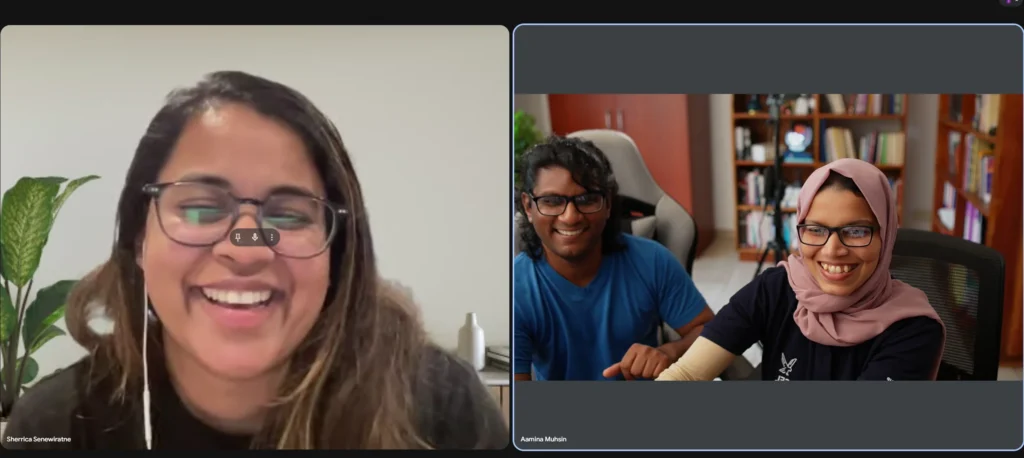
Initially, we wanted to use Riverside for the recording (something we have done in the past), but we figured it would be better if she recorded directly on her devices and used the Blackmagic Camera App to give her full access to all the controls of her phone.
This gave us access to Apple Log on her iPhone 15, but her iPad didn’t have the capability to record in Apple Log. It also gave us a way to increase the data rate, so more information is preserved.
We did a few test shots, tried out a few ways to set things up, and once finished, asked her to transfer to us over OneDrive.
The test shots showed the iPhone footage to be fantastic (iPhone 15 is almost as good as a pro camera and Apple Log helped preserve tons of details), but the iPad was a bit rough around the edges.
Still, we thought maybe with a bit of work we can make it work. So we opted to use both: iPhone as primary and iPad as secondary, this gives us 2 angles.
We scheduled a shoot day and went ahead with planning out the rest of the shoot content.
Aamina worked with Dr. Sherrica to nail down the things she wanted to talk about. She sent over her first draft, and it was good, but a little basic.
That’s where our first big value prop comes in, we deep dive into the ideas and think through how we want to frame each idea, follow up questions, thoughts, or clarifications, cut ideas into 2 or 3, derive new ideas, etc. We sent her back our notes, and Sherrica was over the moon!
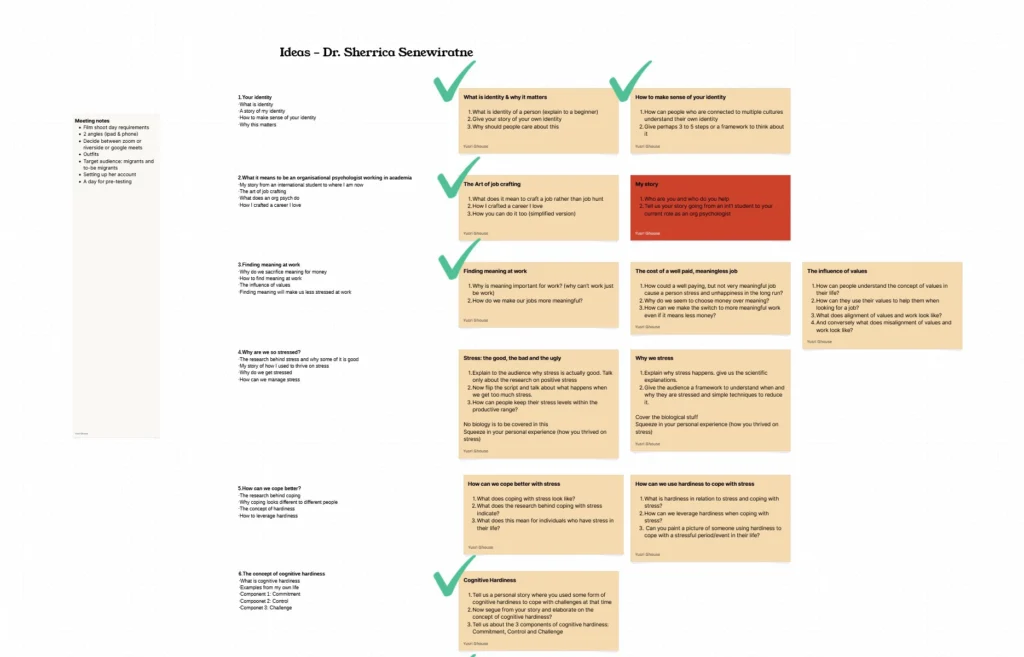
She reminded us at the end that working with us helped distill the ocean of thoughts and knowledge in her mind into salient and digestible chunks that can be video content.
From the get-go, Sherrica has maintained that she doesn’t want scripted content; she wants things to be impromptu. Of course, she will prepare, but she wants it to come in her own voice.
This meant we had to now take Sherrica’s round 2 of ideas, and we went through everything, and what was originally just 10 ideas she sent had ballooned into 20 or so. So we picked 10 for the first batch and asked her if that’s the 10 she wanted to start with. She swapped a few and finalized the 10 ideas we were going to delve into.
And with that we were off to the races. It’s time to film!
Production went about as smoothly as you can imagine. We had to wake up really early for this one, cause we wanted to get the best of the sunlight and since she was in Aussie land, the time difference meant early morning for us. I (Yusri!) was there at the start to help with the setup of the camera settings in the Blackmagic Camera App and to tackle any specific technical issues.
Aamina was in charge with the course of the interview and handled the entire interview process, guiding Sherrica through each interview question and prompting her on the talking points.
I remained on stand-by for technical problems, while Aamina smoothly handled the entire interview. We encountered one problem where Sherrica actually ran out of space on her iPhone, but she cleared out some space and recorded the ending without any problem.
The post-production was a little chaotic. We had another client overlap with Sherrica (scheduling problems with that client, and some confusion led us to overlap accidentally). A lesson really for us to improve our scheduling process, which we think is bulletproof now.
The post stage revealed several challenges.
The first big issue was the lighting. It turns out that Melbourne weather is a bit unpredictable, and cloud cover tends to vary wildly during the afternoon.
We started filming in the morning (Aussie time), but by the time the latter half of the session began, we faced wild fluctuations in the lighting.
This was a pain to deal with; but luckily, Resolve had some solutions that toned it down, but it wasn’t very pleasant, nevertheless.
Secondly, we had to give up on the iPad footage altogether. The iPhone with Apple Log was able to brave the changes to lighting, but the iPad was just destroyed. It was too bad to use. This meant ugly jump cuts without a second angle, which we had to hide.
Third, despite all our efforts to manage within constraints, it’s still not camera footage with carefully controlled lighting as we do here at the studio, so we had to think about how to make it feel better.
A big part of solving this came from using motion graphics that we created for Sherrica, based on her existing brand colors and guidelines. These graphics helped a lot, and we created several templates for future use so she will always have consistent, brand-aligned ways to communicate her ideas.
Beyond that, we used a lot of stock footage B-roll for general visual breaks and to assist the story.
The challenge we faced here was when we shared some examples with Sherrica. She didn’t like that B-roll videos had faces; she felt her audience would not like it too much if she used too many white faces (especially when it’s an immigrant audience), so we adapted to using mostly silhouetted shots or close-ups of hands, items, etc.
Overall, we are really happy with the results of this one, and just so you can get a feel for it, here are some examples of the work we did for her.